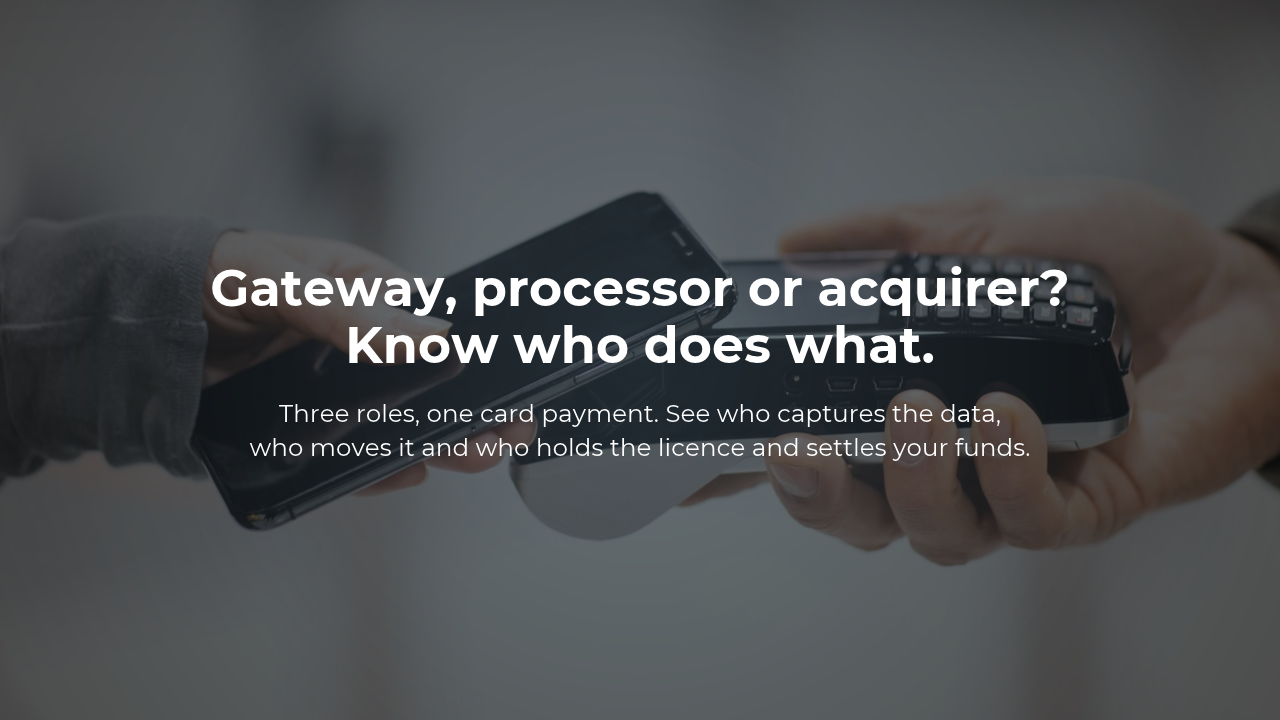
Three words. One card payment. And a surprising amount of confusion over who is actually doing what.
People mix these words up all the time. But they’re three different jobs, and the difference affects how fast you’re paid, who you call when something goes wrong and how many parties sit between you and your money. Here’s the direct acquirer vs payment gateway guide.
Quick answer: what’s the difference?
A direct acquirer holds the licensed relationship with Visa and Mastercard and settles funds to the merchant. A payment gateway is the technology that captures and encrypts card data at checkout. A payment processor moves the transaction data between the merchant, the card schemes and the issuing bank. A gateway cannot move money on its own – it needs an acquirer behind it.
That’s the short version. The rest of this guide shows how the pieces fit together.
What is a direct acquirer?
An acquirer is the financial institution that lets a merchant accept card payments. Mastercard describes it as a merchant’s bank, licensed by the card scheme to help merchants accept its cards. Visa’s glossary frames it as a member that signs the merchant and enters the resulting transactions into the network.
A direct acquirer goes one step further. It holds that acquiring relationship itself, as a principal member of the card schemes. What does it mean in practice?
- the entity that approves your merchant account is the same one that holds the scheme licence
- settlement comes from the acquirer, not from a middle layer
- there’s one contract and one point of contact when you need support
PAYSTRAX is a direct acquirer that holds principal membership with both Visa and Mastercard, and we’re authorised and regulated as a payment institution by the FCA in the UK, MFSA in Malta, and supervised by the Bank of Lithuania in the EU. You can read more about us on our company page.
What is a payment gateway?
A payment gateway is the front door of a card payment. It captures the card details at checkout, encrypts them and passes them on for approval.
Think of it as the technology layer: the checkout integration, the secure data capture, the connection to whoever approves the payment. What it doesn’t do is hold a scheme licence or settle funds. It still relies on an acquirer to complete the transaction.
That’s why “gateway” and “acquirer” aren’t competing options. They’re two layers of the same stack. Some providers bundle both, while others offer only the gateway and route you to a separate acquiring bank. With an online payment gateway built directly on an acquiring licence, the technology and the acquiring sit in one place.
What is a payment processor?
The processor is the engine room. It handles the technical exchange of transaction data: sending the authorisation request through the card scheme to the issuing bank, receiving the response and managing clearing and settlement files.
Processing can be done in-house by the acquirer or outsourced. Here is where the confusion starts – many providers describe themselves as a gateway, a processor and an acquirer all at once, even when only one or two of those roles are actually theirs.
Direct acquirer vs gateway vs processor
| Payment gateway | Payment processor | Direct acquirer | |
| Main role | Captures and encrypts card data at checkout | Routes transaction data between merchant, scheme and issuer | Signs the merchant and provides the acquiring service |
| Holds the card scheme licence? | No | Not necessarily | Yes – principal member of the schemes |
| Settles funds to the merchant? | No | Not usually | Yes |
| Typical use | Online checkout and integrations | Back-end transaction handling | Merchants wanting a direct acquiring relationship |
What about a payment facilitator? A fourth term often joins the conversation: the payment facilitator, or PayFac. Mastercard describes a facilitator as a merchant of record that processes transactions on behalf of sub-merchants. It doesn’t hold the scheme licence itself and relies on an acquirer to settle funds, so it’s a different model to a direct acquirer. If you’re building a platform and want to onboard merchants yourself, our PayFac partnership page explains how that model works with a licensed acquirer behind it.
How does a card payment actually flow?
It takes seconds, but there are more steps than most people expect:
- The customer pays. They enter card details at checkout or tap a terminal.
- The gateway captures the data. It encrypts the details and sends the request on.
- The processor routes it. The authorisation request travels through the card scheme network to the issuing bank.
- The issuer decides. It approves or declines and sends the answer back along the same route.
- The merchant sees the result. The customer gets a confirmation or a decline message.
- Clearing and settlement follow. The acquirer receives the funds through the scheme and settles them to the merchant, after deducting fees.
With a direct acquirer, steps 2 to 6 can sit under one roof. With a separate gateway, processor and acquirer, each handoff is another party, another contract and another place for a question to get lost.
When does a merchant need a direct acquirer?
Not every business needs to think about this. But a direct acquiring relationship matters more as complexity grows. It’s worth a closer look if you:
- operate in a regulated sector where onboarding and ongoing monitoring need a clear, accountable partner
- take payments in several currencies
- sell across the UK and the EU
- need a single point of contact rather than a chain of providers
That’s often the case in the complex industries like forex, financial brokerage and iGaming. These sectors usually need an acquirer that understands their compliance obligations and the way their payment flows behave.
There’s a cost angle too. Many merchants aren’t sure exactly what they pay for card acceptance, or who is behind it. Knowing who your acquirer is, and what you’re paying them for, is a sensible first step. You can see how we approach it on our pricing page.
FAQ
Is a payment gateway the same as a payment acquirer?
No. A gateway is technology that captures and passes on payment data. An acquirer is the licensed institution that provides the acquiring service and settles funds. Some companies offer both.
Can I use a payment gateway without an acquirer?
No. A gateway can’t complete a card transaction by itself. It needs an acquirer to approve the merchant account and settle the funds.
What is the difference between a merchant acquirer and a payment processor?
The acquirer holds the relationship with the card schemes and the merchant. The processor handles the technical movement of transaction data. A direct acquirer may do both.
What is a payment facilitator, and how is it different from an acquirer?
A payment facilitator is a merchant of record that processes payments on behalf of sub-merchants, using an acquirer behind the scenes. An acquirer contracts with and settles to the merchant directly.
Do I need a direct acquirer?
Not always. It tends to matter most for merchants with multi-currency needs, cross-border sales or a regulated business model. If you’re unsure, our FAQ is a good starting point.
The takeaway
Gateway, processor, acquirer: three roles, often blurred together. The question worth asking any provider is simple – who holds the licence, and who settles my funds?
If you’d like to talk through how a direct acquiring relationship could work for your business, get in touch with the PAYSTRAX team.