The world is gradually moving toward a cashless society, where digital payment transactions replace physical banknotes and coins. Advances in payment processing technologies, mobile banking, and digital wallets have made paying easier and faster than ever. However, despite the rapid growth of digital payments, cash continues to play an important role in Europe’s payment ecosystem. Understanding the differences in cash usage across countries, the reasons for its decline, and why it still persists helps explain the complex transition toward a cashless economy.
Cash usage across European countries
Cash usage varies significantly between European countries. According to the European Central Bank (ECB) 2024 Study on the Payment Attitudes of Consumers in the Euro Area (SPACE), cash still accounts for a large share of transactions but the percentage differs widely depending on the country.
Some European economies remain heavily reliant on cash, while others have adopted digital payments much more quickly.
Examples of cash usage in Europe (share of point-of-sale transactions):
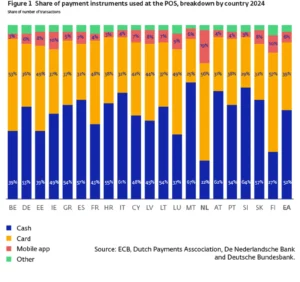
These statistics highlight the clear divide between Northern and Southern Europe. Countries such as Finland and the Netherlands have strongly embraced digital payments, while cash remains dominant in parts of Southern and Central Europe.
Across the entire euro area, cash still represents about 52% of point-of-sale transactions, although this share has declined from about 59% in 2022.
Why cash payments are declining
Several factors explain the steady decline in cash usage across Europe:
Growth of digital payment technologies
The rise of contactless cards, online banking, and real-time payment systems has made digital transactions faster and more convenient than handling physical cash. Financial institutions and fintech companies continue to invest heavily in payment processing infrastructure, making digital payments widely accessible.
E-commerce expansion
Online shopping has become a major part of consumer spending, and digital payments are essential for completing transactions on e-commerce platforms.
Government and regulatory initiatives
Many governments encourage digital payments to reduce the shadow economy, improve tax transparency, and lower the costs associated with cash handling.
Changes in consumer behaviour
Younger generations are more comfortable with digital technology and often prefer mobile payments or online banking over physical money.
Are digital wallets influencing the decline in cash?
Digital wallets are playing a major role in reducing cash usage. Mobile payment services such as Apple Pay, and Google Pay allow consumers to make transactions instantly using smartphones or wearable devices.
The adoption of mobile wallets has grown significantly, particularly among younger consumers who often leave home without physical wallets and rely solely on digital payment apps.
Digital wallets also integrate with loyalty programs, budgeting tools, and online platforms, making them more attractive than cash for everyday transactions. As payment processing systems become more advanced, digital wallets are likely to accelerate the shift toward cashless payments.
More in PAYSTRAX TALKS podcast
Hear more about cashless society and other relevant topics in episode 1 of PAYSTRAX TALKS podcast, featuring our co-founder & Group CEO Johannes Ingi Kolbeinsson and Group CCO Bjarni Thor Sigurdsson 👇
You can also listen to PAYSTRAX TALKS podcast on Spotify: